Some of you may know I'm a fan of the Alice books, by Lewis Carroll. You may also know of Carroll's alternate persona, Charles Lutwidge Dodgson, mathematician of Christ College at Oxford.
Dodgson was one of the polymaths of history: he was a novelist, a poet, a letter writer, a dramatist, an illustrator, a photographer, an inventor, a cryptographer, and yes, a mathematician. Even the peculiar shorthand he invented for writing in the middle of the night evokes the code writing of Leonardo Da Vinci.
When you consider Dodgson's background, the Alice books take on new shades of meaning. Each chapter reveals subtle mathematical references. Take this following paragraph from Chapter 2 of Alice in Wonderland. The context is this: Alice very much wanted to get out of the small hole, but can't, remarking "Oh, how I wish I could shut up like a telescope!" Alice has just found and drunk the "DRINK ME" and starts shrinking.
'What a curious feeling!' said Alice; 'I must be shutting up like a telescope.'
And so it was indeed: she was now only ten inches high, and her face brightened up at the thought that she was now the right size for going through the little door into that lovely garden. First, however, she waited for a few minutes to see if she was going to shrink any further: she felt a little nervous about this; 'for it might end, you know,' said Alice to herself, 'in my going out altogether, like a candle. I wonder what I should be like then?'
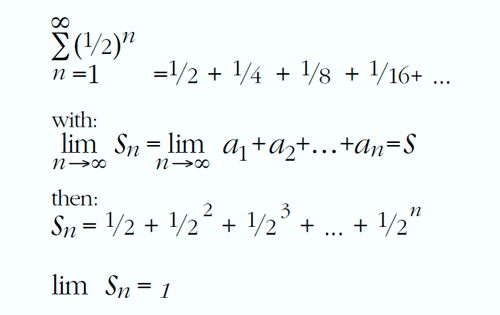
(image credit: Phil Mole)
Here, it seems to me that Carroll is referring to convergent infinite series, an example of one is illustrated above. Indeed, it seems to stretch smaller and smaller, like a telescope: 1/2, 1/4, 1/16, 1/32... Luckily, the series, evaluated using the limit as n goes to infinity, actually sums to a finite amount (1), allaying Alice's fears of "going out altogether, like a candle. "
A conservative, Dodgson mistrusted the growing abstraction in Victorian mathematics; he used Wonderland to take whimsical jibes at his contemporaries. An famous and oft-referenced scene in Wonderland --Alice's tea party with the March Hare, Mad Hatter, and Dormouse-- pokes fun at William Rowan Hamilton. An important guy, not the least because I know he's on the NAQT's You Gotta Know top-ten list of mathematicians.
He occupies the tenth spot on the list, and apparently "you gotta know" he "extend[ed] the notion of complex numbers to four dimensions by inventing the quaternions, a non-commutative field with six square roots of -1..."
Essentially, regular complex numbers (of form a+bi, where i=√-1) occupy two dimensions, but Hamilton's odd quaternions occupy four. Apparently, when Hamilton attempted to extend complex numbers to three dimensions, he couldn't achieve rotation in the system without fudging in a fourth dimension, which he concluded was time, t.
Or should we say, tea.
Lewis Carroll pulls the plug on Hamilton's invention with the mad tea-party, specifically by leaving out the "t." Only three people (not counting Alice, the voice of reason) are present: The Hatter, The Hare, and the Dormouse. The Hatter's friend Time, with whom he has had a falling-out, is absent.
'If you knew Time as well as I do,' said the Hatter, 'you wouldn't talk about wasting it. It's him.'
'I don't know what you mean,' said Alice.
'Of course you don't!' the Hatter said, tossing his head contemptuously. 'I dare say you never even spoke to Time!'
'Perhaps not,' Alice cautiously replied: 'but I know I have to beat time when I learn music.'
'Ah! that accounts for it,' said the Hatter. 'He won't stand beating. Now, if you only kept on good terms with him, he'd do almost anything you liked with the clock.
With Time missing, the clocks at the table are stopped; the system has only three dimensions. The tea partyers move on an endless, nonsensical cycle around the table; they leave behind the used tea-things; any rotation with only three components, as Carroll knew, would be impossible.
To add insult to injury, the following exchange during the party ridicules the weird, non-communicative (i*j≠j*i) nature of quaternions.
Then you should say what you mean,' the March Hare went on.
'I do,' Alice hastily replied; 'at least—at least I mean what I say—that's the same thing, you know.'
'Not the same thing a bit!' said the Hatter. 'You might just as well say that "I see what I eat" is the same thing as "I eat what I see"!'
'You might just as well say,' added the March Hare, 'that "I like what I get" is the same thing as "I get what I like"!'
'You might just as well say,' added the Dormouse, who seemed to be talking in his sleep, 'that "I breathe when I sleep" is the same thing as "I sleep when I breathe"!'
The little tea drama has a happy ending after all. If the Mad Hatter and March Hare could only stuff the Dormouse in a teapot, they would drop a term and become ordinary two-dimensional complex numbers, freeing themselves from the cycle.
... though she looked back once or twice, half hoping that they would call after her: the last time she saw them, they were trying to put the Dormouse into the teapot.
And they succeed, becomes the Mad Hatter comes back for a reprise in the conclusion of Wonderland. But that is a story for another day.
Much indebted to Keith Devlin for making the NPR story "The Mad Hatter's Secret Ingredient: Math" happen. He pointed out what I never would have realized. Also to Melanie Bayley for relevant writing on the subject. An entire senior dissertation!


