Tuesday, December 9, 2014

Book Review: The Rancid Third Floor Cappuccino: A Love Story


Have you ever wondered about that book in the library? Displayed on the cabinet? Written by Penn and Student?


I was lucky enough to get my hands on a copy, even though it's been out of print since 2002. Apparently it's won the Pulitzer and Nobel prizes (I doubt it), but I'll only give it 3.5/5 stars.

I've come to the conclusion The Third Floor Rancid Cappuccino: a Love Story is really a celebration of troper nerdhood disguised as an eccentric YA urban fantasy. In case you're confused: Tropers are those people that uncover and categorize tropes, the devices and conventions of media. (Trope names are written in small caps throughout the book, which was pretty jarring at first.)

Anyway, here's the premise. Rancid is set in Metaverse, a universe that's built on and runs on (capital-T) Tropes. Earth, one of the prisons of Metaverse, is locked down to prevent any (capial-S) Stories from forming on it. That's because (Capital-T) Tropers, the world-hopping citizens of the Metaverse, can wield Tropes only while a Story is active.

Unbeknownst to Earth's wardens, the inmates of Earth have been organizing a jailbreak. When they set off a Story, a small high-school in the quiet town of Biertown-Metropolis gets caught in the cross-fire. But THERE ARE NO COINCIDENCES, and THE PLOT THICKENS.

There are few things I noticed about the setting. Rancid is blatantly set in University Laboratory High School,  I mean, come on. The town called's Biertown-Metropolis, an obvious analogue to Champaign-Urbana. Characters sometimes eat on Red Street, and two of them live in ECL (Electronic Computing Library).

The authors likely intended these parallels: after all, they did choose U.N.I. Penn and A. Student as pseudonyms. Reading Rancid as a current student, I couldn't help feeling like it was a peculiar sort of real-life fanfiction. Walking around Uni after finishing, I couldn't help thinking: this is where _____ died. That's the roof _____  jumped off of. If I touch this wall the right way, I can summon Santa Claus.

I also couldn't help thinking: by fanfiction standards, Rancid is a decent read.


The Rancid Third Floor Cappuccino: A Love Story
U.N.I. Penn and A. Student
3.5/5 stars
"A celebration of troper nerdhood disguised as an eccentric YA urban fantasy."


Thursday, November 13, 2014

Fanfiction: A Confession

"He was surprised to find it wasn’t just bravado. There was an anger boiling in him now he hadn’t felt since before the crash: not the weary contempt on which he’d strung his nights of exile, the shambling, dumb resentment that had filled his pan like static, a clouded haze of cheap beer in green glass bottles and red pills popped from plastic blisters and shot glasses brimming with clear liquid, trash spilt in damp back alleys and the sour tang of vomit in his nose. Seeing Aradia, dead and solemn and alone, had shaken something free: a memory of rage, at least. It was an old rage, quick and fierce, and he hugged it to him like hot coffee on a winter morning.

All of this was code, and he broke code."
-The Vienna Game, by paraTactician


"ring rign the phone went as davee got ot of bed. he pickiced it up and it wuz his fav pokemon professor OAK! 'hey oak howz it going" dave asked. very god dave" oka replied. it is time for u to come get a pokermon now dave so get 2 my lab quickl!"

-DAVE STDIDER POKEMON TRANER, XxXCascadaerXxX


THE FANFIC READER'S MANIFESTO
I recognize that 97% of fan fiction is trash.
I recognize that 2% of fan fiction will make you lose faith in humanity.
I make no apology for my actions.
====================================

Fanfiction has significant stigma attached to it: this is for good reason. Most people describe their fanfction experiences as horrible, if not traumatizing, and have stopped after reading a single piece. My fanfiction experience can described as an exercise in bone-headed determination.

The truth is that I got into reading fan fiction when I was pretty young, and my standards were pretty low. This is probably the only reason I was able to continue; the quality of most fanfic is indeed what you might expect it to be. Really, really, bad. Not ironically bad, as Fernadium Birmingwatt might intend, but just unreadably awful.

Finding fan fiction isn't like finding original fiction. There are no aggregate reviews to help you make your decision. There are no established authorities on fanfic that rank, collect, and recommend fan fiction, such as Goodreads or even Amazon does for fiction.

Finding fanfcition is a high-risk, high-reward process, and a more intimately personal one. Recommendations are always spread word of mouth online, via individuals. There is no Kirkus Book Review or New York Times bestseller's list to look to. Instead, there are three main sites for fan fiction: Archive of Our Own, generally known for a higher quality of work, Fanfiction.net, the original fanfcition site with he greatest quantity , and Wattpad.

(Short rant: Wattpad is trash. There is nothing worth reading on Wattpad, or if there is, it is very, very well hidden. Sturgeon's Law (most of everything is trash, but some stuff is good) simply does not apply. I am sorry. I usually do not present such strong opinions, but no self-respecting fanfic writer is writing on Wattpad, a cesspool of One Direction and various TV fanfic. Take the notorious fanfic, After, a One Direction fanfic. Horrifyingly, it was tapped to become a movie by the Hollywood Talent Association. It's bad. Really, really bad.)

But once in while, you discover a gem of fan fiction. A true sparkling piece worthy of canon, with spot-on characterization and impeccable style. The thrill of finding one is the only reason I trawl through walls of atrocious prose. I know very few such stories; I can count them with one hand.

Considering good fanfic's rarity, is reading fanfic worth it, after all? The answer is yes. The question, unfortunately, is continuously ambiguous. Which retina will you sacrifice? What unspeakable acts will Hedwig engage in? What apostrophes will be slain? What characters, ruined? What dialogue, mangled? What endings, left unfinished?

(If you're interested in Uni's relationship with fanfiction, here's an old Online Gargoyle article on the subject.
http://www.uni.illinois.edu/og/features/2014/05/its-truth-fanfictions-presence-gr)

Thursday, October 30, 2014

Mathematics in Wonderland


Some of you may know I'm a fan of the Alice books, by Lewis Carroll. You may also know of Carroll's alternate persona, Charles Lutwidge Dodgson, mathematician of Christ College at Oxford.

Dodgson was one of the polymaths of history: he was a novelist, a poet, a letter writer, a dramatist, an illustrator, a photographer, an inventor, a cryptographer, and yes, a mathematician. Even the peculiar shorthand he invented for writing in the middle of the night evokes the code writing of Leonardo Da Vinci.

When you consider Dodgson's background, the Alice books take on new shades of meaning. Each chapter reveals subtle mathematical references. Take this following paragraph from Chapter 2 of Alice in Wonderland. The context is this: Alice very much wanted to get out of the small hole, but can't, remarking "Oh, how I wish I could shut up like a telescope!" Alice has just found and drunk the "DRINK ME" and starts shrinking.

   'What a curious feeling!' said Alice; 'I must be shutting up like a telescope.'
And so it was indeed: she was now only ten inches high, and her face brightened up at the thought that she was now the right size for going through the little door into that lovely garden. First, however, she waited for a few minutes to see if she was going to shrink any further: she felt a little nervous about this; 'for it might end, you know,' said Alice to herself, 'in my going out altogether, like a candle. I wonder what I should be like then?'

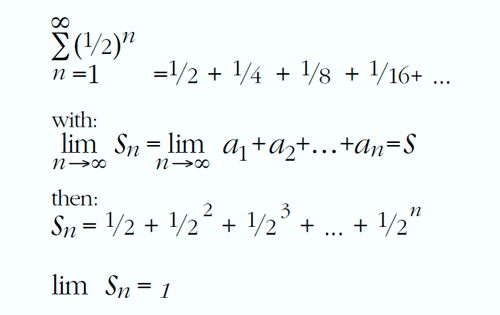
equation
(image credit: Phil Mole)


Here, it seems to me that Carroll is referring to convergent infinite series, an example of one is illustrated above. Indeed, it seems to stretch smaller and smaller, like a telescope: 1/2, 1/4, 1/16, 1/32... Luckily, the series, evaluated using the limit as n goes to infinity, actually sums to a finite amount (1), allaying Alice's fears of "going out altogether, like a candle. "

A conservative, Dodgson mistrusted the growing abstraction in Victorian mathematics; he used Wonderland to take whimsical jibes at his contemporaries. An famous and oft-referenced scene in Wonderland --Alice's tea party with the March Hare, Mad Hatter, and Dormouse-- pokes fun at William Rowan Hamilton.  An important guy, not the least because I know he's on the NAQT's You Gotta Know top-ten list of mathematicians.

He occupies the tenth spot on the list, and apparently "you gotta know" he "extend[ed] the notion of complex numbers to four dimensions by inventing the quaternions, a non-commutative field with six square roots of -1..."

Essentially, regular complex numbers (of form a+bi, where i=-1) occupy two dimensions, but Hamilton's odd quaternions occupy four. Apparently, when Hamilton attempted to extend complex numbers to three dimensions, he couldn't achieve rotation in the system without fudging in a fourth dimension, which he concluded was time, t.

Or should we say, tea. 

Lewis Carroll pulls the plug on Hamilton's invention with the mad tea-party, specifically by leaving out the "t." Only three people (not counting Alice, the voice of reason) are present: The Hatter, The Hare, and the Dormouse. The Hatter's friend Time, with whom he has had a falling-out, is absent. 
'If you knew Time as well as I do,' said the Hatter, 'you wouldn't talk about wasting it. It's him.'
   'I don't know what you mean,' said Alice.
   'Of course you don't!' the Hatter said, tossing his head contemptuously. 'I dare say you never even spoke to Time!'
   'Perhaps not,' Alice cautiously replied: 'but I know I have to beat time when I learn music.'
   'Ah! that accounts for it,' said the Hatter. 'He won't stand beating. Now, if you only kept on good terms with him, he'd do almost anything you liked with the clock.
With Time missing, the clocks at the table are stopped; the system has only three dimensions. The tea partyers move on an endless, nonsensical cycle around the table; they leave behind the used tea-things; any rotation with only three components, as Carroll knew, would be impossible. 

To add insult to injury, the following exchange during the party ridicules the weird, non-communicative (i*j≠j*i) nature of quaternions.
Then you should say what you mean,' the March Hare went on.
'I do,' Alice hastily replied; 'at least—at least I mean what I say—that's the same thing, you know.'
'Not the same thing a bit!' said the Hatter. 'You might just as well say that "I see what I eat" is the same thing as "I eat what I see"!'
'You might just as well say,' added the March Hare, 'that "I like what I get" is the same thing as "I get what I like"!'
'You might just as well say,' added the Dormouse, who seemed to be talking in his sleep, 'that "I breathe when I sleep" is the same thing as "I sleep when I breathe"!'
The little tea drama has a happy ending after all. If the Mad Hatter and March Hare could only stuff the Dormouse in a teapot,  they would drop a term and become ordinary two-dimensional complex numbers, freeing themselves from the cycle.

... though she looked back once or twice, half hoping that they would call after her: the last time she saw them, they were trying to put the Dormouse into the teapot.
 And they succeed, becomes the Mad Hatter comes back for a reprise in the conclusion of Wonderland. But that is a story for another day.


Much indebted to Keith Devlin for making the NPR story "The Mad Hatter's Secret Ingredient: Math"  happen. He pointed out what I never would have realized. Also to Melanie Bayley for relevant writing on the subject. An entire senior dissertation!

Thursday, October 16, 2014

ironie (GEST POST BY Fernadium Birmingwatt)

Disclaimer: This post was mostly written by guest writer Fernadium Birmingwatt, a possibly deranged individual. Regular readers of Continuous Ambiguous are recommended to back away, hands up.  I cannot be held responsible for any of the content hereafter.                                     
-
-
-
-
-
-
-
-
-
Of course, irony is a term much misused, but for the purposes here it may mean: expressions that subvert intent, a sort of smirking duplicity.

I am fond of a particular type of irony: specifically, stuff that's intentionally so bad, it's worse.

Here is a poem I wrote, on the spiritual significance of crop failure in American rapper society:

Ratchet up them HOES
by Fernadium Birmingwatt

Them farmers be all like
RATCHet up tem HOES

And then they till the soil 
and then they till their TOES

and them farmers feed their families
with sick BEETS

them families be dying CAUSE
the beets are so leet


Another one, on the uniting effect of sports drinks on American politics:

Mr. Gatorade-tm goes to Washington d.c. 
Fernadium Birmingwatt

chug chug chug chug
chug chug chug chug

the capital hill shouted to 
BRACk OBOMA

he is getting his 
hydration on.

little did he know Joe Biden
was

the vice president of 

gatorade.


Another one,  on the tragedy of people thinking Shakespeare did not write Pygmalion

AGAGAAH: five couplets on the authorship debate of Pygmalion
by Fernadium Birmingwatt

AGAAHH
i am so pissed

that people actually 
think SHAW wrote 
it

because comners could not write plays that 
are good

get it straight
(dunkasses)

SHAKESPEARE WROTE 
aLL THE DAMN plaise


A final one on the grim truth of dragon fruit.

your fruit be dragging
by Fernadium Birmingwatt

draggin fruit
more like
nagging fruit

more like
GRAPES of wrath


Wednesday, October 1, 2014

Ephemeroptera

Photo Credit: Neil Rettig ©John Downer Productions

Mayflies fascinate me. Even their classification, Order Ephemeroptera. It comes from the Greek word ephermoros, literally meaning "living or lasting for one day." and from which we also get ephemeral.

Their greatest tragedy is not that they live for but one day-- well, half an hour to twenty-four hours depending on the species. They actually live a quite a long time, because of the nymph stage of their lifespans: a year, but even two to three years in some species. Compare this to the life-span of some other insects, such as the monarch butterfly (one month larva, 4-52 weeks adult) or even the short-lived dragonfly (two years nymph, 16 weeks adult).

After completing the nymph stage, the mayfly becomes a sub-imago; essentially an undeveloped and sexually premature adult that will undergo one more molting to reach the adult form.

(This might be fanciful, but I don't think it's an accident that the adult form from the mayfly is called "imago", the latin word for "image." The original meaning is "a likeness." And the pre-adult stage: sub-imago, something even less. )

In a huge cloud of insects, mayflies from the sub-imago stage rise out of the water simultaneously, and after maturing, they mate and die simultaneously. I hope to be able to see this wonder one day. Below is one of my favorite (and highly informative) videos of the phenomenon, as well as a poem.


Friday, September 19, 2014

Winging it


You sit in the audience and the din is deafening.

Picture an gymnast entering the mat. She demonstrates a series of finely-tuned, graceful elbow licks. The crowd goes slack-jawed, then wild. She throws up her arms in triumph; the judges rush orders for new signs reading "11."

Picture a track athlete coiling at the starting block. The gun goes off. He suddenly lifts up his teammates' feet and they madly wheelbarrow down the track. They put real wheelbarrows to shame; the competition halts and kneels in a show of deference and awe.

Picture a swimmer executing a perfect flip-turn. As she pushes off, she just keeps flipping. She flips like mad. This is flipping the likes of which you have never seen. She is the human dynamo; it is her. The other swimmers rush to land because suddenly the water is too hot to handle.

Picture a pianist sitting down at the instrument. You have been promised some famous Chopin Etude or another, and you would very much like to hear it. He begins to play some unfamiliar hogwash. You begin to suspect that is not a very good rendition of Chopin. He begins to bang with abandon and atonality. Just as the crowd rises for a standing ovation, you begin to realize he had no idea what he was doing,

Four equally ridiculous propositions, although perhaps more so the last one.

Freestyle improvisation is a faded subject among classically trained pianists: I have heard no advocates among the ones I know. This is for good reason. You will find few or no competitions for piano improvisation. Like elbow licking or rapid aquatic somersaulting, improvisation simply isn't a very useful skill for us classically-trained musicians.

Even the exuberant cadenzas that typically close piano concertos, formerly improvised-- are now written out. That particular spark of individuality has been lost. Indeed, when Kurt Vonnegut has Ed Finnerty (of Player Piano, a dystopian novel on the dominance of machines over people) assert his humanity by "savagely improvising" on a player piano, it is one of the most memorable moments of the book.

And we might not remember how Beethoven established his reputation as a pianist in Vienna; he wrecked Daniel Steibelt in an improvisation contest. Steibelt, a well-known virtuoso, finished his effort to enthusiastic ovation, but Beethoven came to the piano, made a mockery of Steibelt's theme-- and then to add insult to injury, went on to use it in his Eroica symphony. #Rekthovened

So despite the flurry of concerts and competitions that a pianists might undergo, the hailstorm body of evidence for "it isn't a good idea to waste your time improvising," I think that winging it still holds some merit. A peculiar thing happens, when you begin improvising.

You see, when you start, you truly have no idea what you're doing. You don't know which themes you'll develop. You don't know which tonalities you'll move into. When your fingers first touch the keys-- for that second-- you are lost in an unfamiliar city.

But this city is on closer inspection not at all unfamiliar. Over there, by the street corner, is Jack Sparrow, and flying between skyscrapers is Nausicaa, and Rachmaninoff nods sagely from a park bench,  The streets are cobbled together from the sum total of all you've ever heard, and down them you walk.

You don't really control your path, because Debussy stumbles into your path and nudges you this way. And Tony "Radiation" Fox prods you that way. And Shostakovitch shoves you and goodness, it is getting loud. And pretty soon you feel that, no, you're not playing this instrument.

You sit in the audience, and the din is deafening.


Wednesday, September 3, 2014

Continuous Ambiguous


This is a blog named after a painting. You haven’t seen it.


Inside sits a faded, grayscale old man, looking out of a window-- looking somewhat sad, somewhat numb, with his frown held in an ambiguous counterpart to Mona Lisa's smile. And all around him spiral arcs of solid, glowing color: reds, yellows, greens, and more.  Eel-like, they stream from the wall, from furniture, from his clothing; they loop around him, brush against him, and tunnel through the window.


What struck me was how oblivious that grey old man was. Those strange ribbons invading his mono-color world: did he not see them, for his reverie of the window? Did he not feel them, as they touched his cheek? Surely, he must have heard them, as they whooshed through the air?  And yet he simply does not give a damn. On his face plays an fantastic ambiguousness, so perpetual, so eternal, so continuous. Neither red nor yellow nor green stays this man from frowning his queer little frown.


Many years have passed since I saw that painting, at a local high school art competition.


The painting didn't win, somehow. There are many enigmas in life; that was one of them. It also didn't place second, or third, or honorable mention, or even viewer's choice. A generic still life, full-color, took first, I think, and a photograph of a child, full black-and-white, took second, maybe. As a friend of mine once said, “what is this random crap!”  I don’t claim to remember much of any of it, and this is why: from one glance we know exactly what this (five apples, a kid in a swing) is.


But Continuous Ambiguous! I imagine it must be sitting in an attic somewhere, forgotten, the spirals of colors fading into a uniform grayscale. The owner must think it a failure, and chalked it up to a wild lapse in judgement. Perhaps one day, grown grey, he might climb the attic, offer the old man a cautious lol! what is this random crap! and retreat, biting his tongue in sympathy for a younger self.


Or perhaps not. Perhaps to this day, Continuous Ambiguous hangs proudly on the artist’s bedroom wall, as my own failed submission from that day does. Truthfully, it doesn’t matter. To quote Cookie Monster, that great dispensary of wisdom: “C is for Cookie, and that’s good enough for me.” I have seen it, and that’s good enough for me.


Art is in the eye of the audience, after all; whether the performer chooses to bow at the end is up to them. I, however, will clap regardless, politely, for the artist, for creating a work that brings together so neatly: continuity (the quelling of death); ambiguity (the quelling of staidness); hope.


Because that old man? I think he knows, about hope. Chalk it up to a wild guess. I think he knows, that those swirling colors do not come from nowhere. No, I think he understands they are the lost companions-- children, even-- of the monochrome world around him.


He stares out the window because he isn’t sure whether they are coming-- or going.